
Knee decompression therapy · Columbus, OH

Knee pain relief without surgery.

A nonsurgical approach to knee arthritis, chronic knee pain and stiffness: gentle, controlled knee decompression on the Knee On Trac™, combined with a personalized rehab plan, so you can move more comfortably.

No referral needed3000 Corporate Exchange Dr, ColumbusMon–Fri

What is knee decompression therapy?

Living with knee pain, arthritis or stiffness? Knee decompression therapy is a nonsurgical, noninvasive treatment that uses gentle, controlled traction to unload the knee joint for a short time. In our office it’s done on the Knee On Trac™, an automated knee traction system. It involves no surgery, needles or injections.

Your knee is one of your body’s largest weight-bearing joints. It’s where the femur (thighbone), tibia (shinbone) and patella (kneecap) meet. Smooth articular cartilage covers the ends of the bones, and two C-shaped menisci help spread out your weight. Ligaments, tendons and the surrounding muscles hold it all together. Years of loading, old injuries, extra body weight and wear-and-tear changes can lead to cartilage wear, inflammation, stiffness and chronic knee pain.

How it works

You sit back in the Knee On Trac chair while it supports your leg and applies gentle, controlled traction across the knee. The goal is to temporarily reduce compression inside the joint, ease discomfort, and make movement and rehab exercises more comfortable.

Our equipment: Knee On Trac™

The Knee On Trac is an automated knee traction system made by Ergo-Flex Technologies.

  • You sit back comfortably in a padded chair with a back cushion.
  • Your leg rests on the traction unit, held in place with a thigh strap and a calf strap.
  • A pneumatic air bladder applies gentle, adjustable traction to the knee joint.
  • Sessions are short, typically about 5 to 10 minutes.
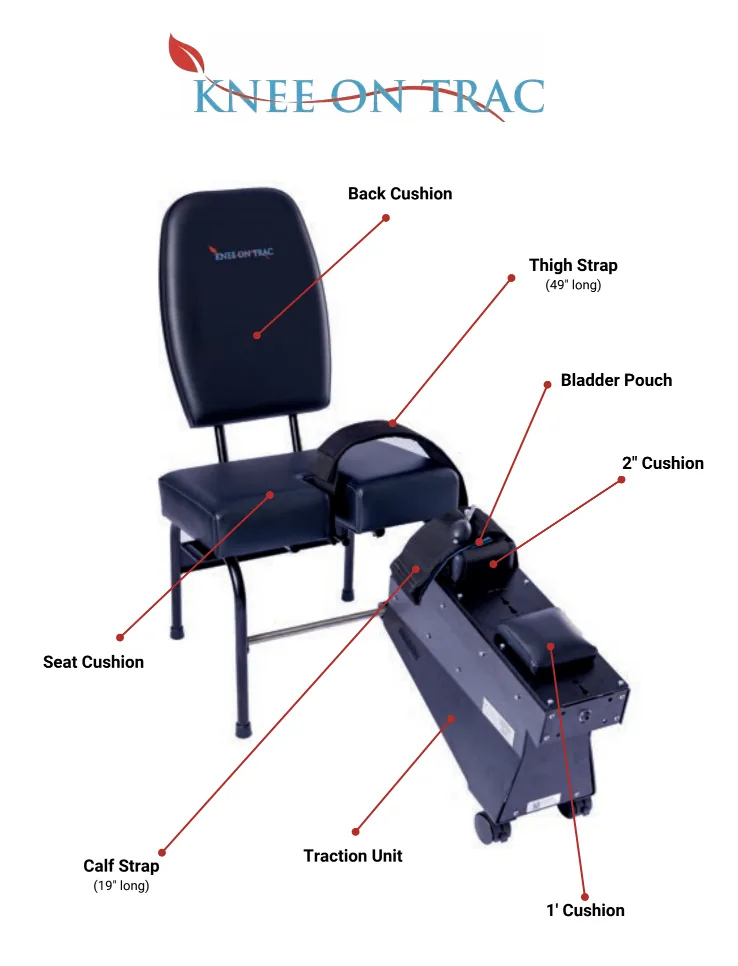
Knee On Trac knee decompression machine at Westerville Chiropractic in Columbus, OH.
The Knee On Trac™ system we use at Westerville Chiropractic.

Potential benefits

Results vary from person to person. For appropriately selected patients, knee decompression may help with:

Reduced knee discomfortSome patients notice less pain, pressure or stiffness after treatment.
Improved mobilityGentle traction may help the knee tolerate movement more comfortably.
Reduced stiffnessMay make it easier to bend and straighten the knee.
Temporary joint unloadingTraction may lower the load on parts of the knee while it’s applied.
Better participation in rehabWhen pain eases, strengthening exercises are often easier to keep up.
A nonsurgical optionOne more conservative step to consider before more invasive care.
Important medical distinctionKnee decompression does not remove arthritis, repair torn cartilage or menisci, or regrow lost cartilage. Its purpose is symptom relief, temporary unloading and support for rehab. Limited research suggests mechanical knee traction may provide short-term improvement in pain and function for some people with knee osteoarthritis, especially alongside exercise and physical therapy. More research is needed.

Knee conditions we evaluate

Every knee is different, so eligibility is decided one patient at a time after an exam. We commonly evaluate:

Knee osteoarthritisWear-and-tear arthritis that causes aching, stiffness, swelling and pain with standing or walking. People with mild to moderate knee osteoarthritis may be candidates for a trial of decompression alongside exercise.
Degenerative meniscus conditionsChronic wear of the meniscus, often with arthritis. Decompression may be part of symptom care, but it does not repair a torn meniscus.
Patellofemoral arthritisPain around or behind the kneecap with stairs, squatting, kneeling or long sitting. Care focuses on movement, quad and hip strength; decompression is considered selectively.
Chronic knee stiffnessTrouble fully bending or straightening the knee. Care may combine decompression with stretching, mobility work, hands-on care and strengthening.
Chronic knee pain from repetitive activitySquatting, climbing, lifting or standing all day at work or play. Care may include activity changes, progressive strengthening and decompression for selected patients.

Common signs of knee osteoarthritis

  • Pain when walking or standing for long periods
  • Stiffness after sitting or first thing in the morning
  • Difficulty climbing stairs, squatting or bending
  • Reduced knee range of motion
  • A chronic, aching knee

We may also see chondromalacia, arthritis after an old injury, chronic pain after a previous knee injury, and other degenerative or mechanical knee problems. These aren’t automatic reasons for knee decompression; your exam decides what’s appropriate.

Are you a candidate for knee decompression therapy?

You may be a candidate if you:

  • Have knee osteoarthritis or a chronic mechanical knee problem
  • Have had knee pain for weeks, months or years
  • Feel stiff after sitting or when you first get up in the morning
  • Hurt when walking, climbing stairs or standing for long periods
  • Find knee pain limits chores, exercise, hobbies or work
  • Still have symptoms after changing activities or trying other conservative care
  • Want to explore nonsurgical options
  • Have a stable knee with no signs of a serious injury
  • Are willing to take part in a rehab program when it’s recommended

The best way to find out is a comprehensive knee evaluation with our clinical team. Call (614) 384-0800 or schedule your knee evaluation.

Safety and precautions

Not everyone is a candidate, and we always examine you before recommending treatment. A suspected fracture, an acute major ligament injury, an active infection, severe instability, a suspected blood clot, or unexplained significant swelling needs further medical assessment first.

Special care is also needed if you have:

  • Recent knee surgery
  • A knee replacement
  • Significant osteoporosis
  • Inflammatory joint disease, such as rheumatoid arthritis
  • Certain vascular or neurological conditions

We review your medical history and the Knee On Trac manufacturer’s guidelines before deciding whether decompression is appropriate. If it isn’t a good fit, we’ll recommend another option or refer you to the right provider.

What to expect during knee decompression therapy

01

Comprehensive knee evaluation

We review your history, symptoms, past injuries, limitations and prior treatment. The exam may include range-of-motion, strength, orthopedic and stability testing, a gait and functional assessment, and a review of X-rays or MRI findings when needed.

02

Comfortable positioning

You sit back in the Knee On Trac chair, and your leg is secured to the traction unit with a thigh strap and a calf strap.

03

Controlled decompression

The Knee On Trac’s air bladder applies gentle, adjustable traction across the knee. It’s meant to feel gentle, not painful. We watch your comfort throughout and adjust or stop if anything feels wrong.

04

Rehab and function

When appropriate, decompression is paired with exercises for the muscles that support the knee: quad, hamstring and hip strengthening, range of motion, balance, gait training and a home program.

Thigh strapCalf strapAir bladderGentle tractionTraction unitKnee decompressionSeated, leg strapped in, gentle traction
Your leg is strapped to the traction unit while gentle, controlled traction is applied.

How often you come, how long each session lasts and how many sessions you need depend on your diagnosis and how you respond. Your plan is explained at your report of findings, before anything is scheduled.

More than knee decompression: a comprehensive approach to knee pain

Our focus isn’t just on calming your knee pain for a day. We look for what’s contributing to it and build a personalized plan to support mobility, strength and long-term function. Knee decompression is one part of that plan, not a stand-alone fix. For knee osteoarthritis, exercise and strengthening have a much stronger evidence base than knee traction on its own.

Depending on your exam, your plan may include:

  • A thorough musculoskeletal evaluation and gait assessment
  • Physical therapy with our onsite PTs and PTAs: therapeutic exercise and progressive strengthening in our exercise area
  • Mobility and balance training
  • Hands-on joint care and massage therapy
  • Activity changes, patient education and a home exercise program
  • Knee decompression on the Knee On Trac when it’s clinically appropriate

When appropriate, knee decompression can be paired with Class IV laser therapy, shockwave therapy and physical therapy.

Once your knee is moving better, wellness care helps you keep your progress. Knee pain after a sports injury? See our sports chiropractor page. Arthritis in more than one joint? See arthritis & joint pain.

Start with the $50 new patient special.Consultation, exam, X-rays if needed, and a report of findings. Call (614) 384-0800 or schedule your knee evaluation.
FAQ

Questions patients ask about knee decompression therapy

Still have a question? Call (614) 384-0800 and our front desk will help.

What is Knee On Trac?

The Knee On Trac™ is an automated knee traction system made by Ergo-Flex Technologies, and it’s the knee decompression equipment we use. You sit back in a padded chair, your leg is secured to the traction unit with a thigh strap and a calf strap, and a pneumatic air bladder applies gentle, adjustable traction to the knee joint.

Is knee decompression therapy painful?

It’s meant to be gentle and comfortable. Some patients feel a mild pulling or stretching sensation around the knee. Significant pain isn’t expected, and treatment can be adjusted or stopped if you feel discomfort.

Is knee decompression the same as spinal decompression?

No. Knee decompression focuses on the knee joint. Spinal decompression is a separate treatment for disc and nerve problems in the low back and neck.

Can knee decompression help bone-on-bone arthritis?

People with advanced osteoarthritis can be evaluated, but results are uncertain. Traction doesn’t restore lost joint space or regrow damaged cartilage. Severe arthritis may need additional medical or orthopedic care, and we’ll tell you if we think that’s the case.

Can knee decompression prevent knee replacement surgery?

There isn’t enough clinical evidence to say knee decompression prevents or delays knee replacement. It may be one part of a broader conservative plan for appropriately selected patients.

Can knee decompression help a torn meniscus?

It may be considered for some patients with chronic meniscus-related discomfort, especially when arthritis is also present. It does not repair a meniscus tear. A new injury, locking or significant instability may need further evaluation.

How many knee decompression sessions will I need?

It depends on your diagnosis, how severe your symptoms are, how you respond, and your rehab goals. We build a personalized plan after your evaluation.

Is knee decompression covered by insurance?

Coverage depends on your carrier, plan, medical necessity and the services provided. Our office can review your benefits and discuss any out-of-pocket costs before you start.

Can I receive treatment on both knees?

If both knees hurt, we’ll evaluate both. Your care plan will explain how each knee is treated based on your exam.

Is knee decompression better than cortisone injections?

They work differently, and current evidence doesn’t show knee decompression is better than corticosteroid injections. The right choice depends on your diagnosis, health history and symptoms.

Do I need surgery for knee arthritis?

Not necessarily. Many people manage knee osteoarthritis with conservative care such as exercise, strengthening and weight management when appropriate. Surgery may be considered when symptoms stay severe despite good conservative care.

What should I do if I have chronic knee pain?

Start with a comprehensive knee evaluation. Finding the cause of your pain tells us which treatment options make sense for you.

New patients welcome

Take the first step toward better knee mobility.

Knee pain shouldn’t run your day. Start with a knee evaluation to learn whether knee decompression therapy may be right for you. $50 new patient special: consultation, exam, X-rays if needed, and a report of findings.